What’s Up to You: Leading When Nothing Feels Certain


Part 1 of Finding Firm Footing, a three-part series on leading through uncertainty.
Dana was COO of a healthcare services company with about 2,000 employees, owned by a private equity firm. In February, the firm announced a “strategic review” of its portfolio. No timeline, no details. Everyone understood it could mean a sale.
For six weeks, Dana did what capable executives do. She tried to get control. She called the operating partner twice a week asking for a timeline. She built scenario models. Her Monday leadership meeting turned into a speculation session. With the company in limbo, top performers were quietly taking recruiter calls. Luis, her VP of Operations, finally said it out loud: “We’ve worked together for five years. You’ve been a great leader. Let’s get back to running the business rather than focusing on what we can’t control.”
Dana isn’t alone. When the future feels as uncertain as it does today, most of us grab for whatever we can hold. But there’s a better approach — and it goes back a couple of millennia.
Modern Problem, Timeless Answer
Epictetus was born into slavery in the Roman Empire around A.D. 50 and became one of the most influential teachers of Stoic philosophy. His handbook, the Enchiridion, opens with a sentence that leaders have been rediscovering ever since: “Some things are in our control and others not.” In our control, he said, are our opinions, our impulses, what we pursue and what we avoid. Outside it are our bodies, our property, our reputations, our positions. In other words, nearly everything modern executives spend their days worrying about. These are things that, at best, we can only influence.
Even our thoughts are only partly within our control. While we can’t decide which thoughts show up in our minds, we can decide what we make of those thoughts. Two executives might both wake up at 3 a.m. thinking, “We’re headed for layoffs.” But one treats the thought as an urgent truth and the other brushes it off as just noise. As Epictetus put it, people are disturbed not by things, but by their judgments about things.
Then there are your actions: They’re up to you. Their outcomes are not. You can make the call, build the plan and show up for the hard meeting. But whether a deal closes or your team believes you depends on other people.
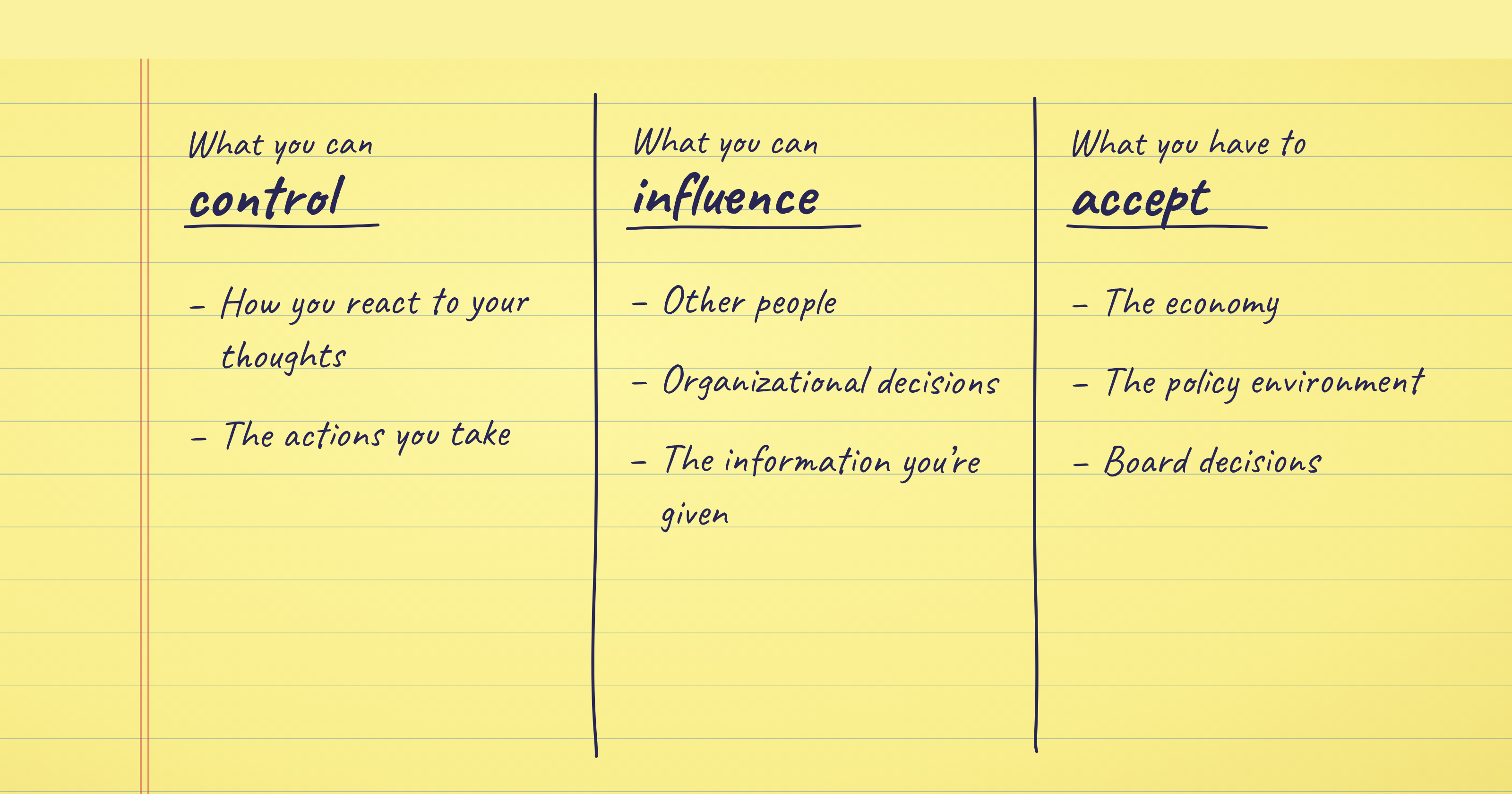
Sorting all this out takes practice. So we often ask leaders to draw their own 'control/influence/accept” charts. Most of the energy leaders waste in uncertain times comes from putting something in the wrong column of their chart. Usually it’s treating something you can only influence as if you control it, and then feeling like a failure when it won’t obey.
Same Uncertainty, Different Environment
When we did this exercise with Dana, the sale went under “accept” in about 10 seconds. Dana had been treating another item — getting a timeline from the parent company — as something she controlled. So every unreturned call felt like a personal failure. She moved this to the “influence” column. She decided to make the case once, clearly and in writing, for why her people deserved a date. Then she would stop checking her phone.
Next came the “control” column. At an all-hands, she said, “I don’t know how this review ends. Here’s what I do know, and here’s what we’re going to do every week until we find out.” She kept the weekly operations review on the calendar, walked two sites a week and stopped taking the operating partner’s calls during her leadership meeting.
The review ran four more months. Two regional directors who had been interviewing elsewhere stayed. Luis told her the Monday meeting “felt like a business again.” The uncertainty was still there. Dana just changed the culture around it, and her team’s behavior followed.
Your Chance to Reshape Culture
This is where a personal discipline becomes a cultural one.
When a situation is ambiguous, people seek clarity. They look at the leader for cues about how to read what comes next. Developmental psychologists call this social referencing. A toddler facing something unfamiliar checks a parent’s face before deciding whether to be afraid. Adults at work do the same with whoever sits at the top of the org chart. In uncertain stretches, your team reads everything you say and do as evidence of what’s normal, and then they act on it.
That’s the argument at the heart of my book Culture Trumps Everything: Culture shapes employees’ behavior more powerfully than their individual personalities do. Dana’s regional directors were the same people in June that they had been in February. But the norms around them had shifted, so they behaved differently.
3 Steps When Uncertainty Hits
These three steps will keep you focused on what you control, and show your team how to do the same.
1. Sort before you respond. Draw your own chart like Dana’s before you react to an uncertain situation. It will keep you from pouring energy into what you can only influence, not control. Do this exercise with your leadership team. The arguments about which column something belongs in are often the most useful conversation you’ll have that week.
2. Say what you don’t know. Leaders tend to stay quiet until they have answers, and rumors fill the silence. Instead, name the uncertainty plainly; then name what you do know and what you’ll do next.
3. Keep the cadence. Create a ritual. The meetings, site walks and check-ins that run on a schedule are deeds your people can count on. In uncertain times they matter more. (I’ll return to this later in this series, because it is the foundation for building certainty for others.)
Steady Leaders, Steady Teams
Every leader has to navigate through forces no one controls. The pull is either to grab for control you don’t have or to give up the control you do. Epictetus offered a third path, and it turns out to be a cultural one. When you govern your own thoughts and actions, you give everyone watching you a working model for doing the same.
Uncertain times also bring hard conversations, and more leaders are turning to AI to help script them. In my next article, I’ll look at what AI can and can’t do for you and for your ability to empathize.
I’d love to hear your questions and reactions. If uncertainty is showing up in your organization and you’d like to talk it through, you can book a 30-minute Insight Call with me.
Photo credit: Wikimedia Commons, public domain
The Series
Finding Firm Footing: Leading Through Uncertainty
1. What’s Up to You: Leading When Nothing Feels Certain
2. Before the Hard Conversation: What AI Can and Can’t Do for Your Empathy (coming next)
3. Fixed Points: The Rituals That Hold a Culture Steady (coming soon)

